


Long AI conversations often start with clarity.
Ideas flow.
Drafts improve.
Momentum builds.
Then, slowly, something breaks.
The conversation grows longer, important ideas get buried, and what once felt productive starts to feel heavy. You scroll to find one insight. You copy-paste responses so you do not lose them. Eventually, you abandon the thread and start over.
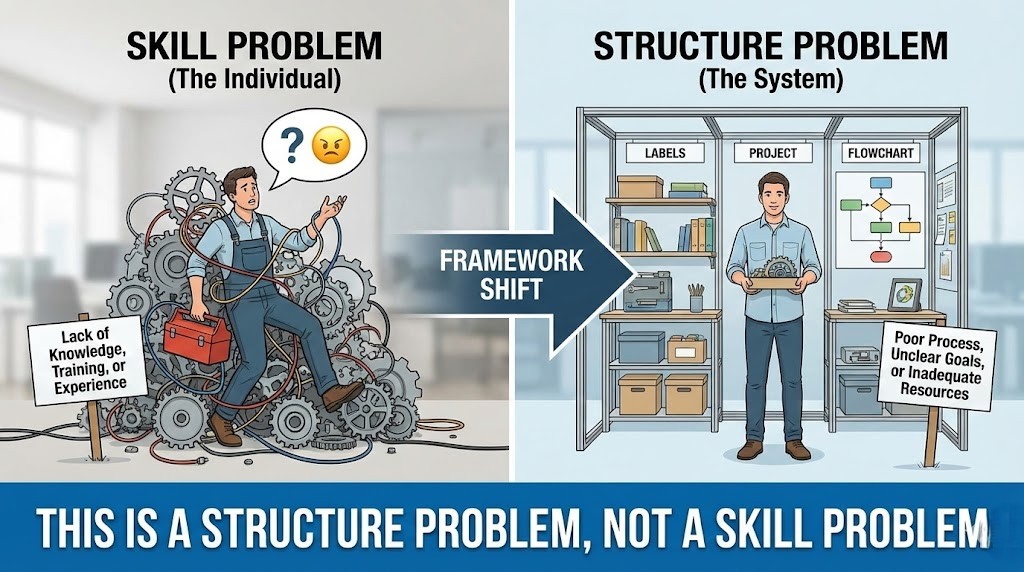
This is not a focus problem. It is not a discipline problem. It is a structure problem.
Why Long AI Conversations Break Down
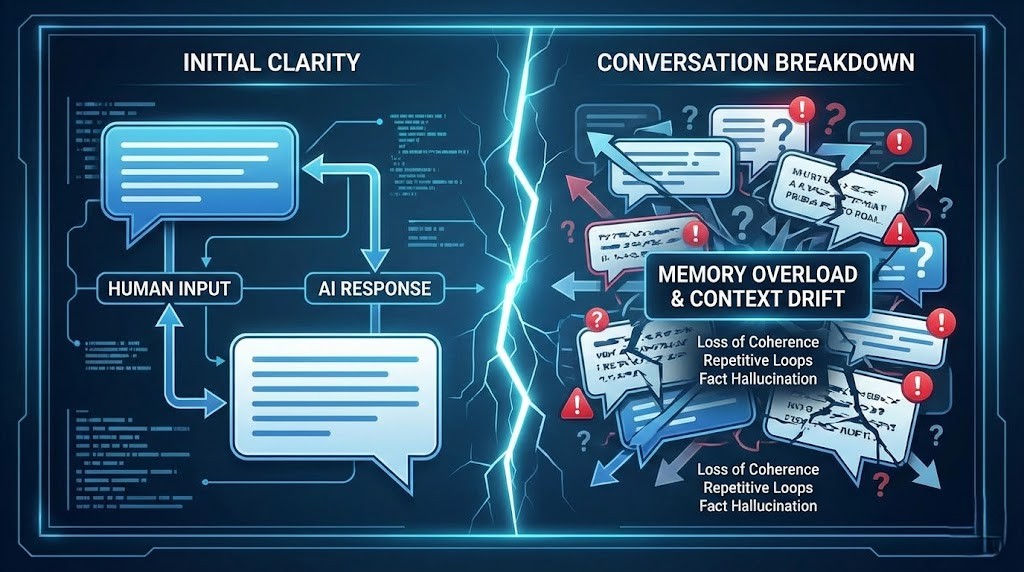
Most AI tools are excellent at generating responses in the moment. They are not designed to actively curate long conversations for you.
As humans, we assume continuity.
We expect important ideas to stand out.
We assume we will “remember where it was said.”
AI does not work that way.
In a long thread, everything is treated equally unless you explicitly say otherwise. A key insight and a casual clarification sit at the same level. Over time, signal and noise blend together.
That is when AI stops feeling like a thinking partner and starts feeling like something you need to manage.
This Is a Structure Problem, Not a Skill Problem
Many people respond to this frustration by trying:
- Better prompts
- Shorter conversations
- External note-taking
Those can help, but they do not address the root issue.
The real issue is this:
AI does not know what matters unless you tell it.
Once you accept that, the solution becomes much simpler.
The TAG & TRACK Approach
The goal is not to make conversations shorter.
The goal is to make them lighter.
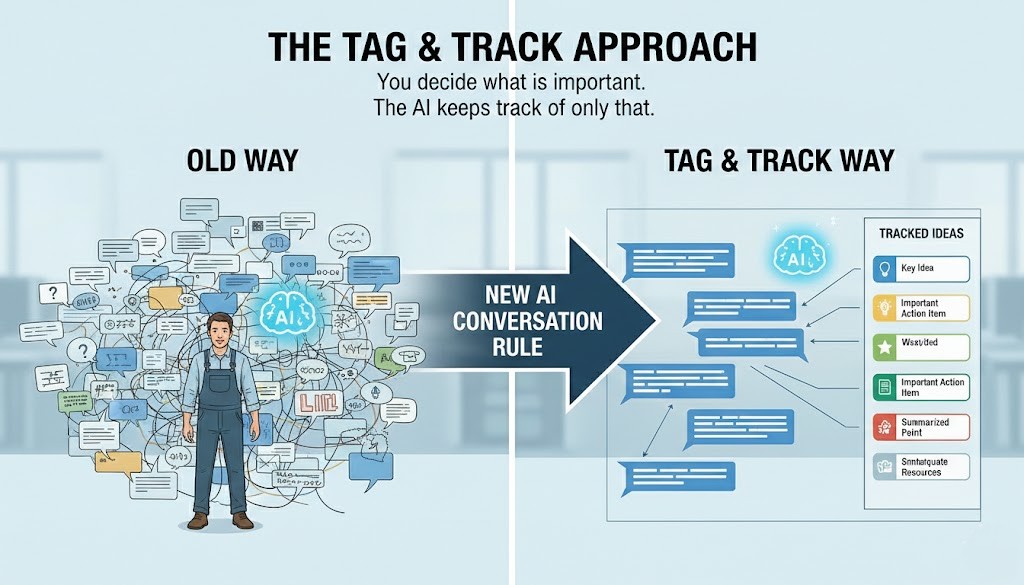
The TAG & TRACK approach introduces a simple rule into any AI conversation:
- You decide what is important.
- The AI keeps track of only that.
Everything else is allowed to be temporary.
This shifts AI from being a passive responder to an active assistant in organizing your thinking.
How the System Works

Step 1: Set the Tagging Rule
At the start of a conversation, you clearly define how you want important messages handled.
Example:
“During this conversation, I will tag important messages by writing ‘TAG: this message’ or ‘TAG: the message above’.
When I do this, save that specific message in a running list.
Do not summarize anything yet.
When I ask for it, give me a clean, organized summary of all tagged items.”
This sets expectations. The AI now knows what to watch for.
Step 2: Tag Only What Truly Matters
As the conversation unfolds, you tag selectively.
You might tag:
- A key insight
- A decision you want to remember
- A framework or step-by-step explanation
- Wording you plan to reuse
You do not tag everything.
Tagging is a signal, not a habit.
After each tag, the AI should confirm that it saved the correct message. If it does not, you correct it immediately.
Step 3: Request a Clean Summary and Restart
When the conversation is complete, you ask for a summary of only the tagged items.
Example:
“Please give me an organized bullet-point summary of all tagged messages from this conversation. Group related ideas together and rewrite them clearly so I can reuse them.”
You then start a new conversation using only this summary.
This is the most important step.
You leave behind the noise and continue working with clarity.
Where This Works Best in Real Life
This approach is especially effective for:
Client strategy sessions
Capture decisions, positioning statements, and next steps without rereading the entire chat.
Content creation
Tag strong phrasing and core ideas while brainstorming, then reuse them cleanly.
Project planning
Keep milestones and constraints visible without managing long threads.
Learning and research
Preserve insights without drowning in source material.
The Common Mistake to Avoid
The most common mistake is tagging too much.
If you tag everything, your final summary becomes just as overwhelming as the original conversation.
Tag only what you want to carry forward.
Everything else is allowed to disappear.
Clarity comes from subtraction, not accumulation.
Why This Matters for Business Owners
AI only creates leverage when thinking stays organized.
When conversations stay clean:
- Decisions are faster
- Cognitive load is lower
- Work is easier to resume
Structure is what turns AI from a tool into an advantage.
Final Thought
AI does not replace thinking.
It rewards structured thinking.
When you tell AI what matters, it becomes easier to move forward with confidence instead of scrolling through chaos.

If you want systems like this built into how your business uses AI, this is exactly the kind of work we focus on at Anterpreneur.
Frequently Asked Questions (FAQs)
Why do long AI conversations lose clarity over time?
Long threads bury important ideas among noise, as AI treats all responses equally without curation. Humans expect continuity, but without structure, signal blends with casual clarifications, turning productive chats into heavy scrolling sessions.
What is the TAG & TRACK approach for AI chats?
Set a tagging rule upfront (e.g., “TAG: this message”), tag only key insights/decisions/frameworks selectively, then request a clean bullet-point summary of tagged items to restart fresh. This keeps AI actively organizing your thinking.
How do you implement TAG & TRACK step-by-step?
Step 1: Define the rule at conversation start. Step 2: Tag sparingly what you want to reuse, with AI confirmation. Step 3: Ask for an organized summary grouped by theme, then begin a new thread with it for lighter momentum.
Where does TAG & TRACK work best for business use?
Ideal for client strategy (capture decisions), content creation (tag phrasing), project planning (track milestones), and research (preserve insights). It reduces cognitive load and speeds resumption without full thread rereads.
What common mistake should you avoid with this system?
Tagging too much—overloading the summary recreates the original chaos. Focus on subtraction: carry forward only what truly advances your work, letting temporary noise disappear for sustained clarity.